A gluten scanner
built on the evidence
Point your camera at a barcode and get an answer in seconds — gluten, 60+ allergens, and the dietary rules you set yourself. Every threshold on this page comes from published research, and so does every answer in the app.
Free, no account. For life-threatening allergies, always confirm with the manufacturer.
- Legal gluten-free limit
- 20 ppm
- Allergens tracked
- 60+
- Studies cited in-app
- 110+
- Languages
- 31
How much gluten is actually too much?
“Gluten-free” has never meant zero gluten. It means below a measured limit — and that limit exists because somebody ran the dose-response trial.
In 2007, a multicentre, double-blind, placebo-controlled trial gave 49 adults with biopsy-proven celiac disease — all on a gluten-free diet for at least two years — a daily capsule containing 0, 10 or 50 mg of gluten for 90 days. Biopsies taken before and after produced the finding that the entire labelling regime now rests on.
Placebo. No change in the intestinal lining, as expected.
No statistically significant deterioration across the group over 90 days.
Measurable damage to the intestinal lining. Clearly harmful.
Catassi C, Fabiani E, Iacono G, et al. Am J Clin Nutr. 2007;85(1):160–166.
What 20 ppm is on a plate
20 ppm means 20 mg per kilogram. Eat 100 g of a product sitting exactly at the limit and you have taken in 2 mg of gluten — a fifth of the dose that caused no significant damage over three months. The safety margin is deliberate.
Who set the number
Codex Alimentarius standard 118-1979 defines it. The US FDA (21 CFR 101.91) and the EU (Regulation 828/2014) both adopt the same 20 mg/kg ceiling for a gluten-free claim, which makes it one number in force across most of the world.
Why your own limit may be lower
The trial reported group averages, and individual sensitivity varied — one participant relapsed on 10 mg a day. A legal threshold is a population-level safety margin, not a personal permission slip. Track how you respond and treat trace exposure as real.
What happens between the camera and the verdict
A scanner is only as good as the way it reads an ingredient list. Here is the whole path, including the step most apps get wrong.
The substring traps
Three common ingredients contain the letters of a gluten grain and are perfectly safe. An app that searches for bare substrings flags all three — and a scanner that cries wolf gets ignored on the day it is right.
- buckwheat · wheatgrass → wheat
- maltodextrin → malt
- modified corn starch → starch
- 1
Read the barcode
The camera decodes EAN-13, UPC-A and the other retail symbologies on the device itself. No photo of your shopping leaves the phone.
- 2
Look up the product
The code is matched against the OpenFoodFacts catalogue — an open database of packaged food, carrying the ingredient text as printed on the pack.
- 3
Normalise the ingredient text
Case, punctuation, brackets and E-number spellings are levelled out, so an ingredient written six different ways is matched once.
- 4
Mask the safe phrases first
Known-safe phrases are matched longest-first and removed from a working copy before any gluten phrase is tested. This ordering is what prevents false alarms.
- 5
Match, then explain
Whatever survives is checked against the gluten and allergen catalogues, and the result names the ingredient that triggered it alongside a confidence score — never a bare yes or no.
Twenty-three seconds, in your language
The walkthrough was recorded in each of the 31 languages this site publishes. It is the real interface, not a mock-up — the same build that ships on the App Store.
- 00:03Scan a barcode and read the verdict.
- 00:09Photograph a plate and let the analysis break it down.
- 00:16Open any of 60+ allergens for symptoms, aliases and sources.
No sound. Around 2 MB — nothing downloads until you press play.
Six screens, captured in your language
Every screenshot here comes from the shipping build running in a simulator, in the language you are reading right now. Nothing on this page is an illustration.
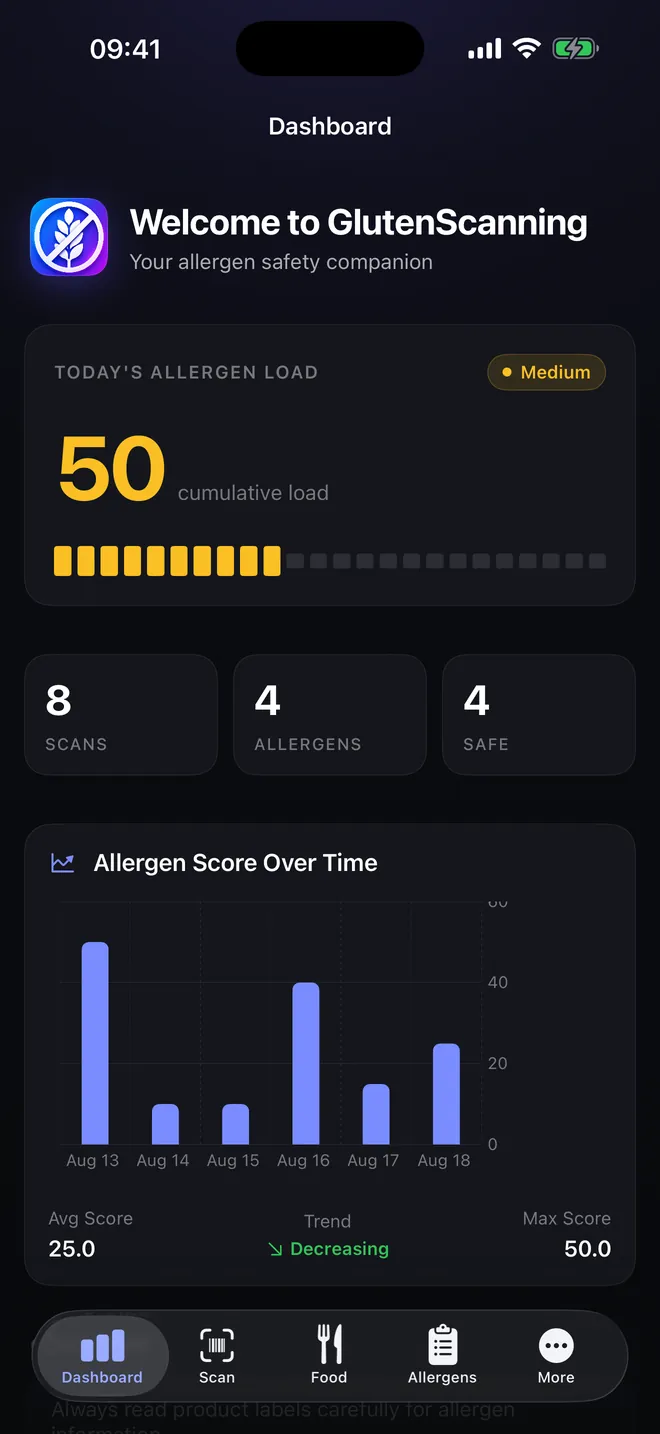
Your allergen load, day by day
A running tally of what you have taken in today, how many products you scanned and how many came back clean — with the trend across the week.
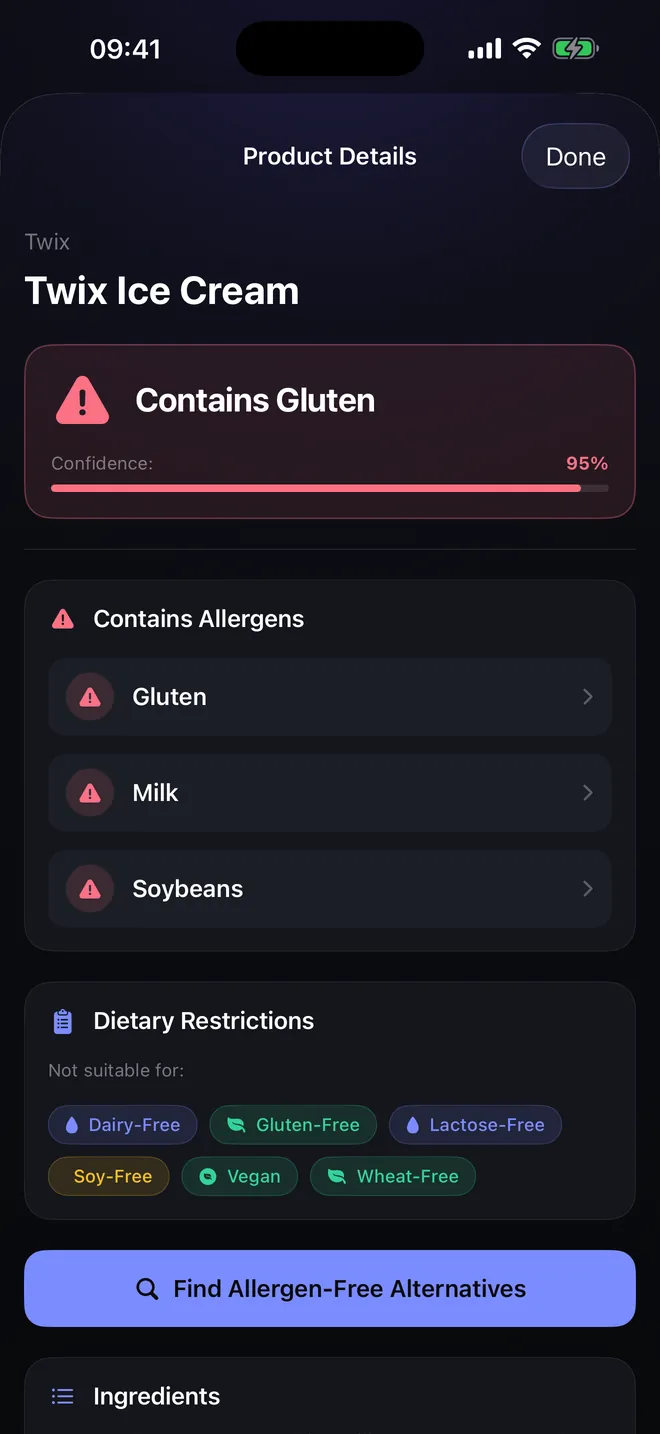
A verdict, and the reason for it
Plain language first — “Contains gluten” — then the ingredient that triggered it, every allergen found, and a confidence score you can weigh up.
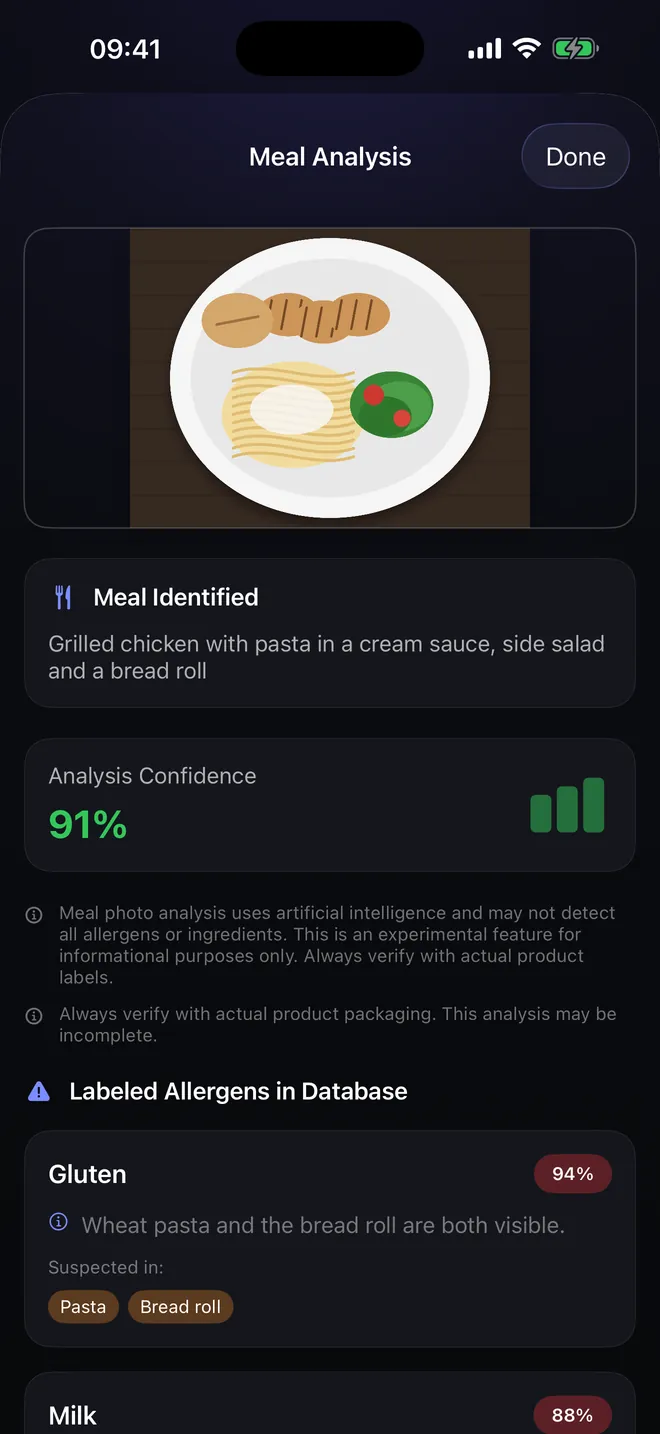
Photograph the plate, not the packet
For food that has no barcode. The analysis identifies the dishes in a single photo and flags the allergens each one is likely to carry.
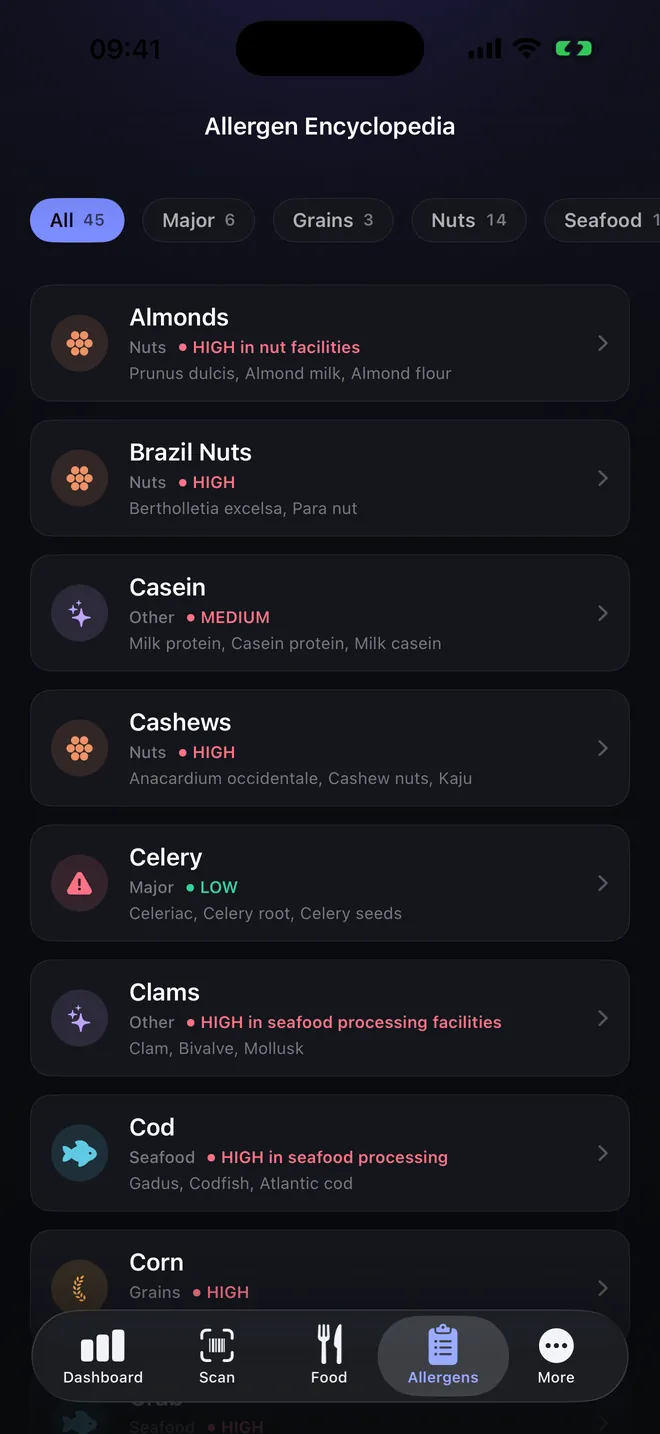
Sixty allergens and their aliases
Every allergen the app tracks, tagged high, medium or low risk, together with the names it hides under in an ingredient list.
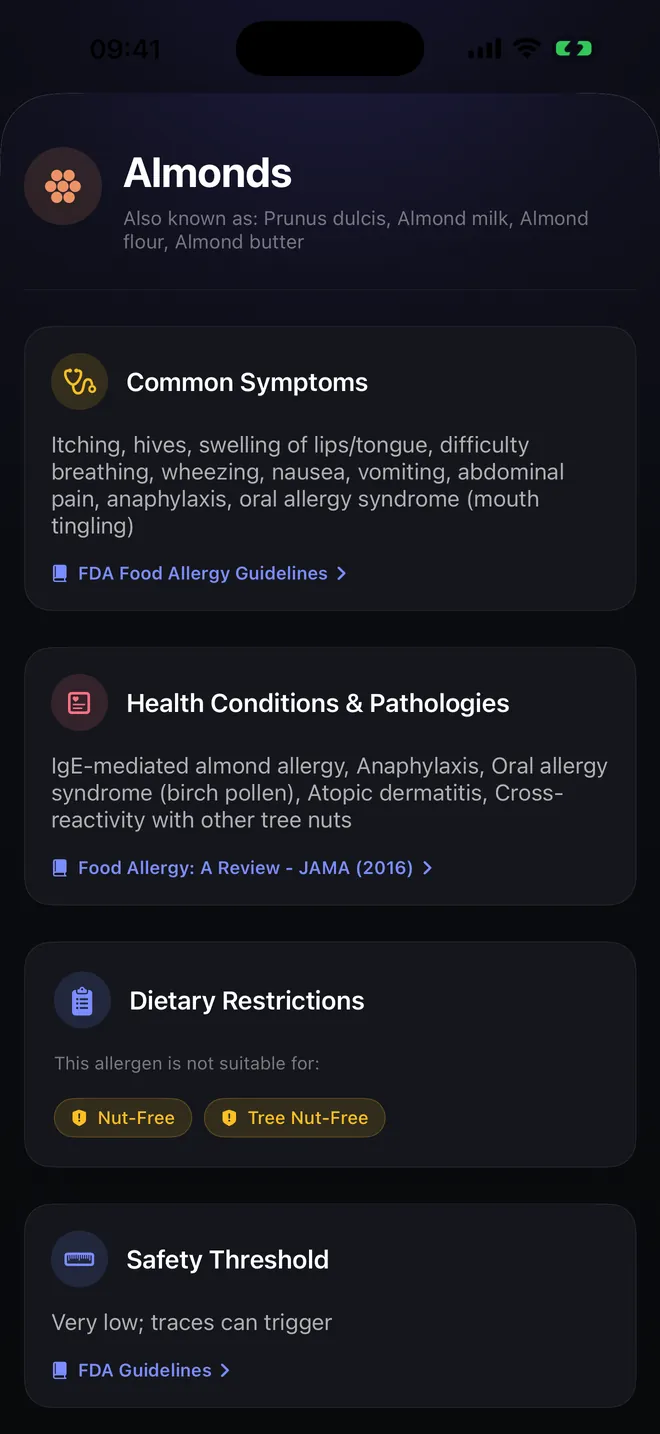
Symptoms, sources and citations
One allergen in full: what it does, where it turns up, and the peer-reviewed sources behind each claim.
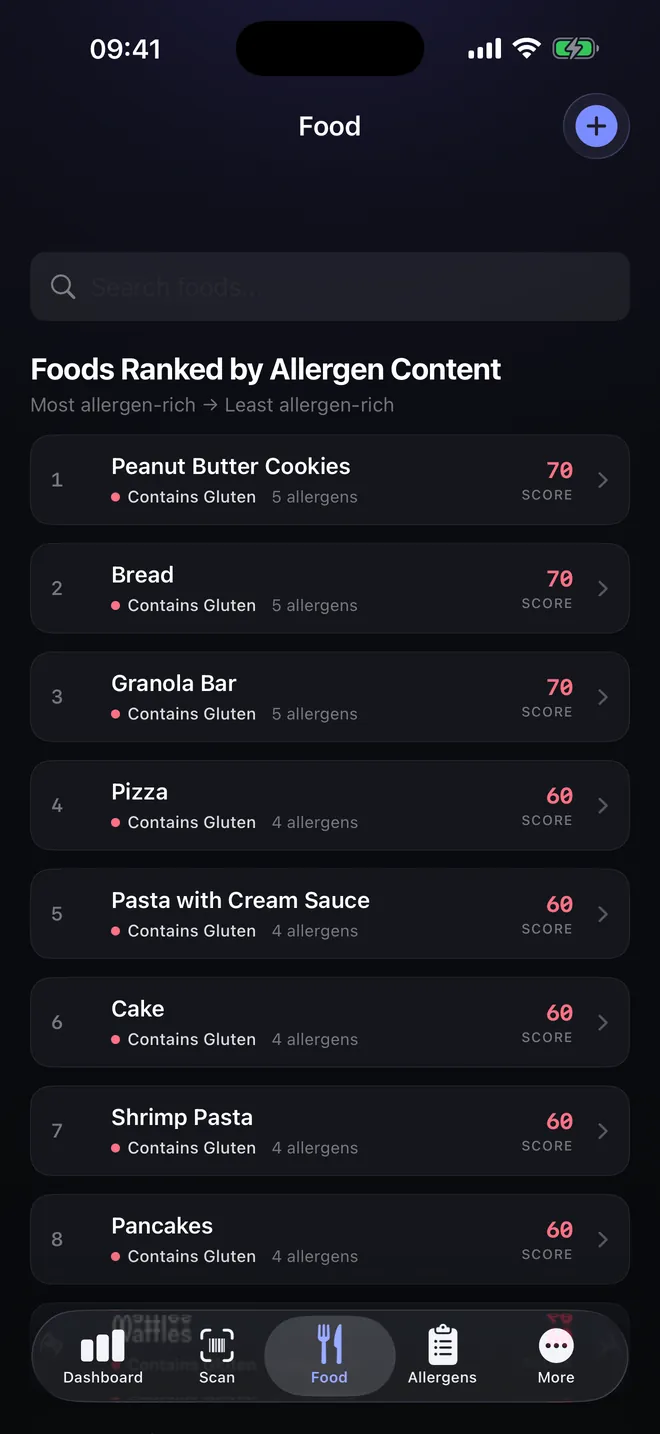
Compare before you choose
Foods ranked by allergen content score, so the lower-risk option is obvious — then tap through for the full breakdown.
Celiac disease, gluten sensitivity and wheat allergy are not one condition
They share a trigger and almost nothing else. The mechanism differs, the test differs, and — the part that matters in a supermarket — the threshold differs.
| Celiac disease | Non-celiac gluten sensitivity | Wheat allergy | |
|---|---|---|---|
| Mechanism | Autoimmune. Gluten drives the immune system to attack the intestinal lining. | Neither autoimmune nor allergic. The mechanism is still not established. | IgE-mediated allergy to wheat proteins. |
| Confirmed by | tTG-IgA serology, then duodenal biopsy — both while still eating gluten. | Exclusion. There is no confirmatory test. | Skin-prick test or wheat-specific IgE. |
| Threshold that matters | Under 20 ppm. Trace exposure counts, with or without symptoms. | Usually a personal tolerance well above 20 ppm, varying widely between people. | Avoid wheat. Severity is about exposure, not parts per million. |
| Risk if untreated | Malabsorption, osteoporosis and a raised risk of certain cancers. | Not established. | Anaphylaxis on exposure. |
One rule outranks the rest: do not start a gluten-free diet before testing. Removing gluten normalises the antibodies and the biopsy, and the tests stop working. Read the full comparison
The numbers that should shape your habits
Three findings that change what a careful shopper actually does — each one a link away from its source.
“Gluten-free” in a restaurant is a claim, not a measurement
Over 18 months, 804 users of a portable gluten sensor uploaded 5,624 tests of restaurant food that had been labelled or described as gluten-free. Gluten was detected in about a third of it, and the worst categories were the obvious ones.
The sensor registers from roughly 5–10 ppm, below the 20 ppm legal limit, and the sample selected itself — people test what they already suspect. The figure describes this dataset, not restaurants in general.
Lerner BA, Phan Vo LT, Yates S, et al. Am J Gastroenterol. 2019;114(5):792–797.
Read the write-up →How common is celiac disease?
1.4%
Antibody-positive
0.7%
Biopsy-confirmed
Pooled across 96 studies and more than 275,000 people. Biopsy-confirmed prevalence works out at roughly 1 in 140 — and most of them do not know it yet.
Singh P, Arora A, Strand TA, et al. Clin Gastroenterol Hepatol. 2018;16(6):823–836.
A negative gene test can rule it out
More than 90% of people with celiac disease carry HLA-DQ2, and most of the rest carry DQ8. Carrying them proves nothing — plenty of healthy people do — but testing negative for both makes celiac disease highly unlikely, with a negative predictive value above 99%.
Blood and gene tests are a doctor’s job. A scanner helps you shop; it does not diagnose anything.
Nine that must be declared, and fifty more that often are not
Every scan is checked against the allergens with statutory recognition in the United States, plus the long tail that regional labelling rules treat differently — and against any dietary rule you set for yourself.
Sesame became the ninth US major allergen on 1 January 2023 under the FASTER Act. The EU requires 14 to be declared, including celery, mustard, lupin and sulphites.
- Milk
- Eggs
- Fish
- Crustacean shellfish
- Tree nuts
- Peanuts
- Wheat & gluten
- Soybeans
- Sesame
Plus 50+ more, from celery and mustard through to lupin, sulphites and nightshades.
A health app that does not want your health data
There is no account, no profile sitting on a server, and nothing to ask us to delete later. Your scan history and dietary rules stay in the app, on your phone.
Read the privacy policy →- No account, no sign-in, no email address.
- Scan history and dietary profile never leave your device.
- Anonymous analytics only, switchable off in Settings.
Questions worth a straight answer
What does GlutenScanning actually check?
Scan a product barcode and the app reads the ingredient list behind it, then checks it against gluten, more than 60 allergens, and any dietary rules you have set. When there is no barcode to scan, it can analyse a photo of the meal instead.
Is it free?
Yes. Barcode scanning and allergen detection are free and need no account. The AI-powered features run on generous daily quotas.
Does it work offline?
Barcode scanning falls back to a local product database when you have no signal. Meal-photo analysis needs a connection.
How accurate is it, honestly?
It reads the ingredient data and label claims that exist for a product, from OpenFoodFacts and the pack itself, and tells you which ingredient triggered the verdict. It cannot detect cross-contamination in a kitchen, and it cannot see a recipe change before the database does. For life-threatening allergies, confirm with the manufacturer.
Which allergens does it cover?
All nine with statutory recognition in the United States — milk, eggs, fish, crustacean shellfish, tree nuts, peanuts, wheat and gluten, soybeans and sesame — plus more than 50 further allergens and intolerances.
Do you collect my health data?
No. There is no account and no server-side profile. Scan history and dietary settings stay on your device, and analytics are anonymous and optional.
Written for people who actually read labels
Longer answers to the questions that come up in the aisle, each one sourced.
What names does gluten hide under?
50+ ingredient names, grouped by whether the word alone settles the question — malt, modified food starch, dextrin, hydrolysed vegetable protein and the rest.
How does a gluten-free barcode scanner work?
The four steps between your camera and the verdict, why two apps disagree about the same tin, and where barcode scanning genuinely fails.
Celiac disease vs gluten sensitivity
Mechanism, testing and long-term risk — including why you must not go gluten-free before being tested.
Product directory
Individual verdicts for the packaged products people look up most, each with the ingredient analysis that produced it.
Check the next thing you buy
Free on the App Store, in 31 languages, with no account to create.
For informational purposes only. Not a substitute for professional medical advice.